Can Meat
Agent runs
Each mode of this task runs once per run. Est. cost is tokens at list price (data/prices.yml), never a bill; see the BEHAVIOR-1K runs for every task of a run.
Codex + GPT-6 Luna, reasoning xhigh (ChatGPT login)default run
| Trial | Started | Agent time | Model requests | Tokens in / out | Est. cost | Grade |
|---|---|---|---|---|---|---|
| U✗ 4h 00m 0% | 09-27 23:44 | 4h 00m | 673 | 95.0M / 237k | $1.20 | deterministic 1, grader_error 0, instance_exact 1, instance_ok 1, n_actions 3201, video_rendered 1 |
| L✗ 2h 24m 0% | 09-28 04:00 | 2h 24m | 436 | 56.4M / 217k | $0.743 | deterministic 1, grader_error 0, live_success 0, n_actions 6079, replay_success 0, video_rendered 1 |
Task instruction (upstream)
Open the kitchen cabinet, take out the two hinged jars, open them, place exactly two cooked bratwursts from the chopping board on the countertop into each jar, then close both jars, put them back inside the cabinet, and close the cabinet.
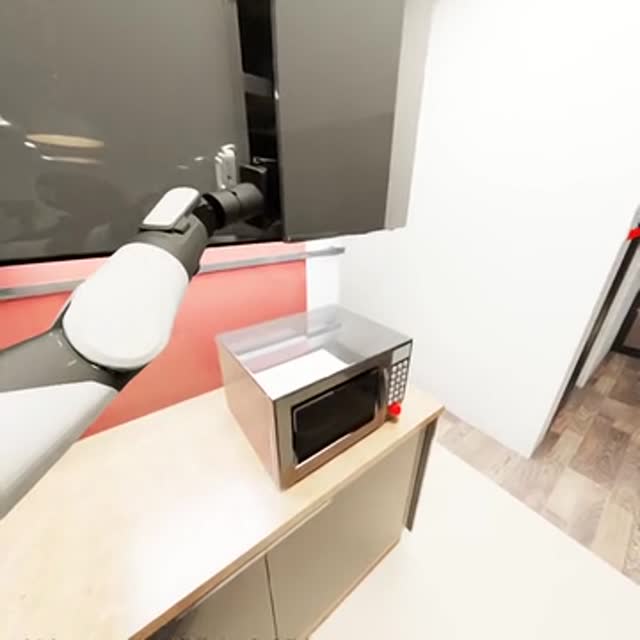
Measured on the stack we run — BEHAVIOR-1K v3.9.2 / OmniGibson 3.9.2 / Isaac Sim 5.1
| Goal predicates | inside open |
| Quantifiers | forall forn |
| Counted quantities | 2 |
| Goal clauses | 4 |
| Objects named in the goal | bratwurst.n.01 cabinet.n.01 hinged_jar.n.01 |
| Objects in the problem | 11 in 7 categories |
| Rooms loaded | corridor_0 dining_room_0 entryway_0 garden_0 kitchen_0 living_room_0 living_room_1 |
| Demonstrations | 200 teleoperated episodes |
| Mean episode | 6m 35s (11,847 control steps at 30 Hz) |
| Base travel, mean | 31.66 m |
| Gripper travel, mean | left 26.06 m · right 28.46 m |
| Evaluation instances | 20 public test instances (ids 301–320) |
Read from BDDL activity definitions + 2026-challenge-task-instances (licensed download), 2026-09-21.
Tags
Skill primitives in the demo: open dooropen lidpick up fromplace inclose lidclose door
Why this task is interesting
One of the densest goals in the suite. The instruction stacks four distinct kinds of constraint into a single 395-second episode:
- A strict order — the cabinet must open before the jars come out, the jars before they are filled, and both must be closed and returned at the end.
- An exact count with a distribution — "exactly two … into each jar" is not "four bratwursts among the jars". Three in one and one in the other fails, and an agent that cannot represent per-container counts will produce exactly that error.
- Low-clearance insertion — a bratwurst into a jar mouth leaves little room.
- A terminal tidiness condition — closing the cabinet is part of the goal, and is the step most likely to be dropped by an agent that stops once the salient objects are placed.
Because BDDL awards partial credit over a conjunction of predicates, this task produces a genuinely informative score rather than a near-certain zero: an agent can demonstrably get most of the way and be measured doing it. That is the property that earns it a slot.
Capability notes
mp.articulated— three articulated interactions of two kinds: the cabinet door, and two hinged jar lids.mp.pick-place— jars out and back, bratwursts from board to jars.mp.insert-fit— the jar mouth is the tight clearance in this task.rea.ordering— open → extract → open → fill → close → replace → close. The order is not incidental; several predicates are unsatisfiable out of sequence.rea.quantifier-grounding— "exactly two … into each jar". A per-container count, which is strictly harder than a global count.per.state-recognition— cooked bratwursts specifically, so the agent must read a non-geometric object state, not just find sausage-shaped geometry.per.container-interior— must perceive inside the cabinet, and inside each jar to verify its contents.
Deliberately not tagged:
phy.thermal— the bratwursts are already cooked when the episode starts. Nothing cooks during the episode, so no thermal transition is required. This one is worth flagging because "cooked" in the instruction invites the tag.mob.multi-room-nav— kitchen only.mp.bimanual— plausible but unverified. An agent may well need one hand to steady a jar while inserting; confirm against the demo before adding it.
Oracle demo review
Not yet watched by anyone on the team. Tagging above is derived from the published instruction text. When reviewing, the two open questions are whether the demo uses both arms for the jar (see above) and whether the teleoperator closes the cabinet, since that terminal predicate is easy to miss.
Discussion
- The
phy.thermalexclusion is the kind of call that should be contested if anyone disagrees — the instruction says "cooked", but no state transition occurs during the episode.